

Introduction: The Shift from Data Availability to Decision Velocity
For the longest time, the “big win” in business was simply having data. We spent the last two decades moving away from paper ledgers and clunky local servers into the cloud. We thought that if we could just see our numbers in real-time, all our problems would solve themselves. But if you walk into any mid-sized company today, you’ll see the same thing: people sitting in front of screens, looking at mountains of data, and feeling more paralyzed than ever.
We’ve reached a point of “Data Availability,” but we are failing at Decision Velocity. It’s the difference between seeing a storm on a radar and actually knowing which way to turn the steering wheel to keep the ship from capsizing. In today’s economy, having the data isn’t a secret weapon it’s just the bare minimum. The real advantage goes to the teams who can look at that data and make a move before the opportunity evaporates.
- The “Clarity Gap” in Dashboards: Most managers wake up to a sea of red and green dots on a screen. Without a story behind those dots, they’re just noise. We’ve traded paper piles for digital piles, but the overwhelm remains the same.
- ERP as the “Operational Truth”: Your ERP has always been the vault where the truth is kept. But that truth is often buried under ten layers of sub-ledgers. AI acts like a searchlight, finding the truth and bringing it to the surface where you can actually use it.
- From Record-Keeping to Judgment: We are moving away from the “System of Record” era. We don’t just need a system that remembers what we bought; we need a “System of Judgment” that helps us decide what to do next.
- Practicality over Futuristic Hype: Forget the sci-fi movies. This isn’t about robots running your company. This is about giving a tired warehouse supervisor the “superpower” to know exactly which three orders need to go out the door first to save a million-dollar account.

The Hidden Problem with Traditional ERP Decision-Making
If you feel like your current ERP is just a glorified digital filing cabinet, you’re not alone. Most ERPs were built by accountants, for auditors. They were designed to make sure the books balanced at the end of the year, not to help a production manager decide which machine to repair on a Tuesday morning.
1. Static Data in a Dynamic Business World
The world moves at the speed of a viral social media post, but traditional ERP reports move at the speed of a glacier.
- The “Post-Mortem” Problem: Most ERP reports are “retrospective.” They tell you that you lost money last month, which is helpful for taxes but useless for saving today’s margins.
- The Manual Middleman: We still see teams exporting data from a $50,000 ERP into a $10 Excel sheet just to try and understand it. This manual step is where errors creep in and where decisions go to die.
- The Lag Effect: There is a dangerous time gap between “something happening” and “someone knowing.” By the time a report is generated and discussed in a meeting, the market conditions have often already shifted.
2. Why Dashboards Alone Don’t Drive Action
We were promised that dashboards would be the “single source of truth,” but they often just lead to more arguments in the boardroom.
- The “What” vs. the “So What”: A chart might show you that sales are down in the Northeast. That’s the “what.” It doesn’t tell you “why” it’s happening or “what” you should specifically do to fix it.
- Bottlenecks and Gatekeepers: When data is hard to interpret, regular staff stop trusting their own eyes. They wait for a “data person” to explain things, which creates a huge bottleneck in the middle of the workday.
- The “Gut Feeling” Trap: When the ERP doesn’t provide a clear path forward, leaders fall back on their intuition. But intuition is often just another word for “doing things the way we’ve always done them,” which is a recipe for stagnation.
Practical Insight: If your team has to hold a “reconciliation meeting” every Monday just to agree on what the numbers actually mean, you aren’t running an agile business; you’re running a museum.
AI’s Real Role in ERP: From Automation to Cognitive Assistance
We need to kill the idea that AI is just about “automation.” Automation is for simple, repetitive tasks like sending an invoice. AI is for thinking. It provides what we call “Cognitive Assistance” helping you process more variables than the human brain was ever meant to handle at once.
1. AI as a Context Engine, Not Just a Predictor
The most valuable thing AI does is provide context. It looks at the “ripples in the pond” that humans might miss because we’re too focused on our own departments.
- Connecting the Silos: AI doesn’t just look at inventory levels in a vacuum. It looks at them in relation to your shipping delays, your cash flow, and even external factors like global shipping routes.
- Contextual Awareness: A smart system knows that “Low Stock” on a Monday morning in December is a panic-level event, while the same level on a Friday in July might actually be a planned phase-out.
- The Ripple Effect: AI understands cause-and-effect. It can tell you that a 5% increase in a raw material price from a specific vendor will wipe out your profit margin on a specific product line three months from now.
2. From Alerts to Explanations
A notification that says “Sales are low” is just annoying. An insight that says “Sales are low because your top three customers are switching to a competitor with faster shipping” is a call to action.
- Democratizing Business Logic: By providing the “reasoning” behind a data point, AI allows a junior employee to understand the business as well as a 20-year veteran.
- Building a Culture of Trust: People don’t follow instructions from a machine they don’t understand. When the AI explains why it’s making a suggestion, your team is much more likely to take the leap.


Turning Live ERP Data into Everyday Decisions
Let’s talk about the actual “shop floor” reality. This is where the money is made or lost not in the quarterly board meeting, but in the hundreds of tiny choices your team makes every single day.
1. Inventory Decisions That Adjust Themselves
Inventory is often the biggest “cash trap” in a company. AI turns that static pile of goods into a fluid, moving asset.
- Identifying “Zombie Stock”: AI can spot products that have stopped moving but are still eating up warehouse rent. It suggests moving them at a discount now rather than letting them become a total loss later.
- Prioritizing the Reorder: Instead of a generic “reorder point,” AI looks at the lead times and the reliability of your vendors. It tells you to order from Vendor A today, even if they’re more expensive, because Vendor B is currently having labor issues.
- Volatility Protection: During a supply chain crisis, humans often panic-buy. AI stays calm, looks at the actual demand signals, and prevents you from over-leveraging your cash on stock you won’t need for a year.
2. Order Management Decisions Without Manual Reconciliation
The “Order-to-Cash” cycle is usually full of “micro-leaks” where profit drips away.
- Catching the Small Stuff: AI identifies mismatches immediately like a customer being quoted a price that doesn’t account for a recent freight surcharge. It catches the error before the invoice is sent.
- Proactive “Firefighting”: If a shipment is going to be late, the AI flags it. This allows your customer service team to call the client and manage expectations before the client gets an angry notification that their delivery is missing.
- Fulfillment Optimization: It can suggest the best warehouse to ship from, not just based on distance, but based on current labor capacity and packaging costs, protecting your bottom line on every single box.
3. Financial Decisions Based on Operational Reality
Finance and Operations often live in two different worlds. AI acts as the bridge that connects them.
- Operational Margin Analysis: Finance usually knows that margins are down. AI tells them why maybe it’s a specific machine that’s running inefficiently or a specific shipping route that’s become too costly.
- The “Living” Forecast: Instead of a static budget that gets ignored by the second month, AI provides a rolling forecast that updates every time a sales order is entered. It turns finance into a proactive partner.
- Real-Time Cash Visibility: It helps you decide which vendors to pay today and which ones can wait, based on your projected cash inflows over the next 14 days.
Rare Insight: Most companies focus on “Financial Truth,” which is essentially history. The real winners focus on “Operational Truth,” which is the future. AI is the only way to see both at once.
Decision Intelligence vs. Business Intelligence
This is a distinction that most software vendors won’t tell you about, but it’s the reason why so many “big data” projects fail.
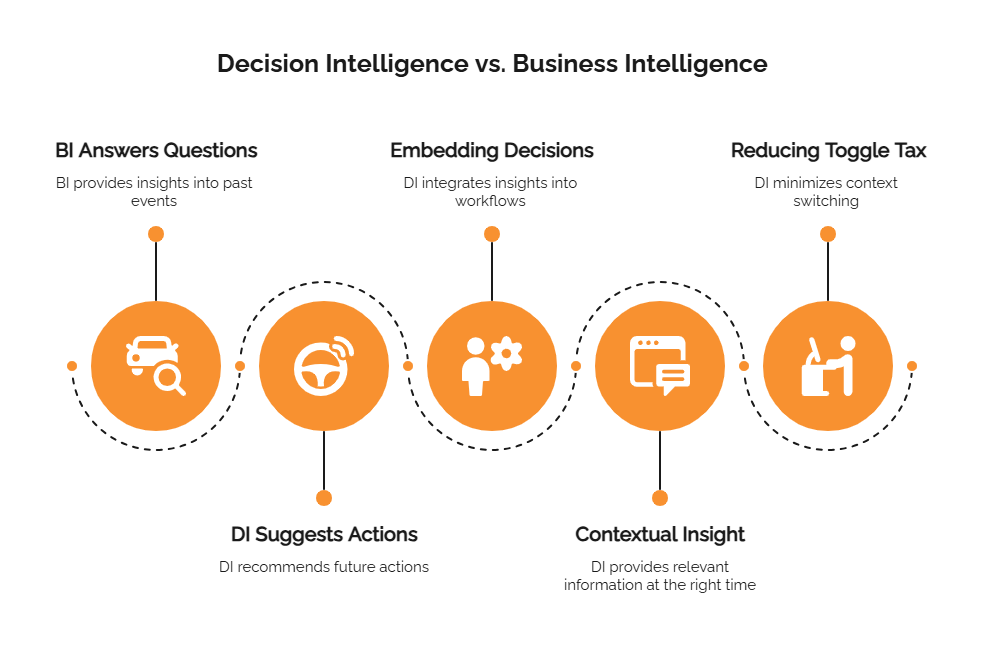
1. BI Answers Questions; Decision Intelligence Suggests Actions
Think of Business Intelligence (BI) as a rearview mirror. It’s great for seeing where you’ve been, but it’s terrible for steering.
- BI (The Past): It’s about “What happened?” It results in a report that sits on a desk.
- DI (The Future): It’s about “What should we do next?” It results in an action that changes the outcome.
2. Embedding Decisions Directly into Workflows
The biggest mistake you can make is forcing your employees to leave the ERP to go use a “data tool.”
- Contextual Insight: The “answer” should pop up right inside the screen where the work is happening. If I’m creating a purchase order, the AI should tell me right then and there that the price is 10% higher than average.
- Reducing the “Toggle Tax”: Every time an employee has to switch between tabs, they lose focus. AI puts the intelligence right in their workflow, reducing the mental fatigue that leads to expensive mistakes.
Trust, Transparency, and Human-in-the-Loop AI
Let’s be honest: nobody wants to be told what to do by a computer they don’t understand. If your staff feels like the AI is a “black box,” they will fight it or ignore it.
1. Why Explainability Matters More than Accuracy
In a business, decisions involve real money and real reputations. You can’t just say “the computer told me to.”
- The Logic Trail: Users need to see the “why.” If the AI suggests a 5% price hike for a loyal customer, it needs to show the data like the rising cost of raw materials to justify that risk.
- Challenging the AI: A healthy system is one where the human can disagree. If a manager knows that a certain customer is going through a rough patch and wants to hold the price, they should be able to override the AI and teach it that “human” context.
2. Supporting, Not Replacing, the Human
The goal isn’t “Artificial Intelligence”; it’s “Augmented Intelligence.”
- The AI as a Research Assistant: The AI does the boring work of scanning 10,000 invoices to find the three that are wrong. The human then uses their expertise to fix those three problems.
- Building Confidence: When the system consistently helps people avoid mistakes, they stop seeing it as a threat and start seeing it as an essential tool like a calculator or a GPS.
How Modern ERP Platforms are Built for AI
You can’t just “bolt” AI onto a legacy system that was written in the 90s. The architecture of the ERP itself has to be different.
- Unified Data: If your “Sales” data doesn’t talk to your “Inventory” data, your AI is essentially blind in one eye. Modern platforms like Versa are built with a single, unified database so the AI can see the whole picture.
- Real-Time, Not Batch: Legacy systems often process data in “batches” at night. But AI needs to work on live An insight about a stockout is useless if it’s 12 hours old.
- Embedded, Not Integrated: You shouldn’t need a team of expensive consultants to “integrate” AI. It should be baked into the core of the ERP, growing and learning as your business transactions flow through it.
Measuring the Impact: What Actually Improves?
When you get this right, you’ll stop measuring “how many reports we ran” and start measuring “how effective our decisions were.”
- Cycle Times: How much faster are we responding to customer requests or supply chain hiccups?
- Escalation Rates: Are senior managers spending less time “putting out fires” because the staff is making better decisions on their own?
- Cross-Functional Harmony: When everyone is looking at the same AI-driven “suggested actions,” the usual bickering between Sales and Operations starts to fade away.
Common Pitfalls to Avoid
I’ve seen many companies spend a fortune on AI and get zero results. Here’s why:
- Treating AI as a “Feature”: AI isn’t a button; it’s a capability. It has to be woven into the culture of how you make decisions.
- Insight Overload: Giving a warehouse manager 100 “alerts” a day is the same as giving them zero. The AI must prioritize the top 3 things that actually matter.
- Ignoring Change Management: You have to talk to your people. Explain that the AI is there to take the “grunt work” off their plate so they can focus on the parts of their job they actually enjoy.
The Future: ERP as a Living Decision Nerve Center
We are heading toward a world where your ERP isn’t just a ledger it’s a living system that “breathes” with your business. It won’t just tell you what happened yesterday; it will help you navigate tomorrow.
Eventually, these systems will become “anticipatory.” They will see a trend in the market and automatically suggest shifting your production schedule before you even realize there’s a problem. The business will move from being “reactive” to being “proactive.”
Conclusion: Small Decisions are the Big Difference
In the end, digital transformation isn’t about the big, million-dollar choices made in the boardroom. It’s about the thousand tiny, “boring” choices made every day by your team.
When you combine AI with your ERP, you are sharpening every single one of those choices. You are moving your company from a world of “I think” to a world of “I know.” The future belongs to the organizations that can decide faster, move with more clarity, and act with total confidence.
The most powerful transformation your business can undergo isn’t digital it’s decisional.
Let Versa Cloud ERP do the heavy lifting for you.


Growth is exciting – but only when your systems grow with you. Versa Cloud ERP is built to support fast-moving SMBs with the tools they need to scale smartly, efficiently, and confidently.
Do Business on the Move!
🌍 Run your business from anywhere – without the growing pains.
Make your businesses hassle-free and cut the heavyweights sign up for the Versa Cloud ERP today!!
Join our Versa Community and be Future-ready with us.