



The Purchase Price Isn’t the Whole Story
A distributor buys a product for $80 and plans to sell it for $120. On paper, that’s $40 of gross profit on every unit. Then the freight bill comes in. Maybe there’s an import duty or a handling charge too. The selling price is still $120, but the profit may not be $40 anymore.
So here’s the question: how much profit does a product really make once you know what it cost to get it? Three points sit behind that question.
- The cost of the manufacturer is just one aspect of the overall situation. What you pay the manufacturer is only the starting cost, not the total cost.
- Hidden costs can have an effect on the profit margin, and even a small amount can be important when purchasing in bulk.
- It is important to have reliable data available about costs. Purchasing and financial departments can calculate profit only if they have complete data.
Why Product Costs Can Change After a Purchase
Let’s look at the usual reasons, in plain terms.
- Freight and shipping. Moving stock from the supplier to your warehouse can cost a lot, especially over long distances.
- Import duties and customs charges. Imported goods often come with charges that raise what you pay.
- Handling and receiving. Getting goods checked in and ready to sell takes work, and that work can carry a cost.
- Supplier price adjustments or invoice differences. The final bill can differ from the quote because of quantity changes, agreed adjustments, or other charges.
Not every expense is necessarily part of inventory cost. How it’s treated depends on what the expense is and which accounting rules apply.
When these costs are missed, delayed, or recorded separately, it gets hard to know what margin you’re really earning.
The Difference Between Purchase Price and Total Acquisition Cost
The purchase price is what’s charged for the goods themselves. The total acquisition cost also includes the other costs of getting those goods ready for sale. Here’s a simple example.
| Cost component | Illustrative amount | Why it matters |
|---|---|---|
| Supplier invoice for goods | $8,000 | Base purchase cost |
| Freight | $600 | Transportation cost |
| Import duties | $400 | Applicable import charges |
| Handling charges | $200 | Cost of receiving or handling |
| Total illustrative cost | $9,200 | Full amount in this example |
In this example, all the extra costs are treated as part of acquiring the inventory, just for illustration. Real accounting treatment may differ.
The total is $9,200, not $8,000. If you only look at the supplier invoice when judging profit, you’ll underestimate what the stock cost you.
Key takeaway: A purchase order sets the expected cost, but you should also know the final costs and how they’re accounted for.
A Simple Example: How Additional Costs Change Gross Profit
Take one product bought in a batch of 100 units, selling at $120 each.
Before additional costs
- Purchase price per unit: $80
- Gross profit per unit: $40
- Gross margin: 33.3%
After additional acquisition costs
- Additional cost per unit: $12
- Illustrative cost per unit: $92
- Revised gross profit per unit: $28
- Revised gross margin: 23.3%
Here’s how the numbers work:
- Initial gross profit: $120 − $80 = $40 per unit
- Additional cost: $1,200 ÷ 100 units = $12 per unit
- Revised cost: $80 + $12 = $92 per unit
- Revised gross profit: $120 − $92 = $28 per unit
The gross margin falls from 33.3% to 23.3%. The selling price didn’t change. The cost basis did.
Gross margin is gross profit divided by selling revenue, times 100. This example leaves out other operating expenses and assumes the full batch sells at the stated price.
Why Delayed or Disconnected Cost Information Creates Problems
When purchasing, inventory, and financial information don’t line up, it shows in daily decisions.
- Pricing decisions. Teams may set prices using old cost assumptions.
- Product comparisons. A lower supplier price doesn’t always mean a lower total cost.
- Purchasing decisions. Buyers may chase the lowest unit price and miss other expenses.
- Profitability reporting. Reports may not show every relevant cost by the time managers read them.
- Financial planning. Surprise expenses open a gap between expected and actual results.
Not every business faces all of this, and not every extra cost affects margin the same way. It depends on the cost, when it’s recorded, and how it’s accounted for.
How Businesses Can Improve Visibility Into Product Profitability
You can do all of this with any ERP system, or none at all.
- Compare purchase orders with final supplier invoices. Look for gaps between what you expected and what you were billed.
- Record relevant additional costs. Keep freight, duties, and other charges visible and classified properly.
- Connect purchasing and financial information. Rely less on separate spreadsheets and hand-matched records.
- Review product costs regularly. Look into meaningful gaps between expected and actual costs.
- Use one consistent profit calculation. Make sure teams know which costs are included when they compare products and margins.
The goal isn’t to collect more data. It’s to have useful cost information at hand when you’re pricing, buying, and reviewing finances.
Where Connected ERP Information Fits In
When purchasing, inventory, and accounting information sit in separate systems or spreadsheets, teams often have to match records by hand before they can understand costs and profit.
A connected ERP approach can bring relevant operational and financial information together, depending on the system’s capabilities and setup.
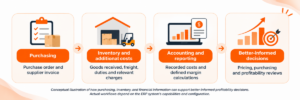
From purchasing to profitability
- Purchasing: Supplier price and purchase order
- Inventory & Receiving: Goods received and relevant cost information
- Financial Information: Invoices, expenses, and appropriate cost treatment
- Better Profitability Decisions: More informed pricing, purchasing, and financial reviews
When the information provided during purchase, inventory, and financial processes are examined, it gives a better perspective on cost breakdowns of the products. This greatly reduces the problem of finding discrepancies in prices and making informed decisions.
How this connects to Versa Cloud ERP
Versa Cloud ERP unites inventory management, procurement, accounting, and reporting so that teams can operate on the same data and not disparate documents. Why is this beneficial? Operations and finance records are brought together so queries regarding costs can be answered more readily.
What Businesses Should Ask Before Evaluating an ERP System
Before comparing any software, see how well your current process answers these questions.
| Question to ask | Why it matters |
|---|---|
| Can we compare ordered costs with final invoice amounts? | Helps spot cost differences. |
| Can we see purchasing and inventory information together? | Cuts the effort of reconciling separate records. |
| How are freight, duties, and other costs classified? | Supports consistent accounting treatment. |
| Can our reports show which cost assumptions are used? | Helps managers read profit figures. |
| Can we investigate differences between expected and actual costs? | Supports better buying and pricing decisions. |
The right solution depends on your processes, your reporting needs, and what you need from your ERP system.
Better Profitability Starts With Better Cost Visibility
Back to that $80 product. The supplier’s price is one part of the profit calculation. Extra costs, incomplete records, and timing differences all change how you see your margins.
Three things to hold on to:
- Understand the costs of acquiring inventory.
- Keep purchasing, inventory, and financial information consistent and easy to reach.
- Use reliable cost information to set prices and make purchasing decisions.
To see how Versa Cloud ERP handles inventory, purchasing, and financial management, visit our site.
Take the First Step Towards Transformation


By taking a collaborative approach, Businesses can build a culture of continuous improvement and achieve sustainable operational efficiency without overwhelming your team or disrupting your business.
Don’t let inventory challenges hold your business back. Discover the Versa Cloud ERP advantage today.
Effectively manage your financials, multiple channel inventory, and production workflows with our award-winning ERP.
Let Versa Cloud ERP do the heavy lifting for you.
Do Business on the Move!
Make your businesses hassle-free and cut the heavyweights sign up for the Versa Cloud ERP today!!
Join our Versa Community and be Future-ready with us.